Why Is My Oven Not Heating But the Stove Works?
Why is my oven not heating but the stove works? Learn the top causes, from a tripped fuse after self clean to a dead bake element or weak igniter.
Need appliance repair? Call now for same-day service.
Call +1 (888) 206-0056Dinner is ready to go in and the oven is stone cold. The stove burners work fine. If you are wondering why is my oven not heating but the stove works, you are dealing with one of the most common oven complaints. It feels strange because the two share one appliance. The truth is simple. The oven and the stove run on separate heat circuits that happen to live in the same box. One can fail while the other works perfectly. This guide walks through the causes, the easy checks, and when to call a technician.
Why Is My Oven Not Heating But the Stove Works?
An oven only heats when its own heat circuit is complete. On an electric oven that circuit runs through the bake element, the temperature sensor, and the thermal fuse. On a gas oven it runs through the igniter and the gas safety valve. The stove top has its own separate burners and controls. So power or gas can reach the stove while the oven circuit sits broken.
The short list of causes covers most cases. On electric ovens: a burned out bake element, a bad temperature sensor, or a tripped thermal fuse. On gas ovens: a weak igniter that glows but cannot open the gas valve. Less common causes include a failed control board and a tripped breaker that only feeds the oven circuit.
Safety First: Unplug the Oven or Shut Off the Gas
Work on a dead oven, never a live one. For electric ovens, unplug the range or flip the breaker off. Electric ovens run on 240 volts, which is far more dangerous than a standard wall outlet. For gas ovens, turn the gas valve behind the range to the off position before you touch any burner part. If you ever smell gas, leave the house and call the gas company first. Do not work on the oven until the smell is gone and the supply is shut.
Electric Oven: the Most Common Causes
About seven in ten no heat oven calls on electric models come down to three parts. Check them in this order.
The Bake Element Burned Out
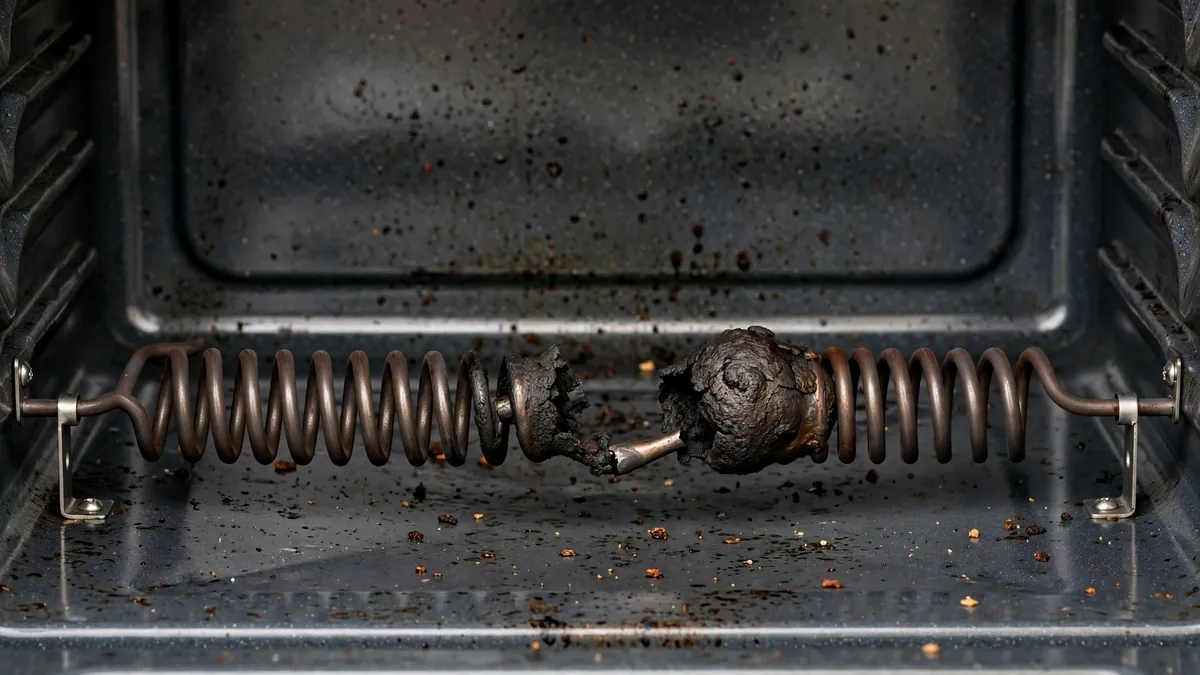
The bake element is the thick coil at the bottom of the oven cavity. It glows red when it heats. Elements wear out with age and heat cycles. Pull out the oven racks and look at the element closely. A dead element often shows a visible break, a blister, or a hole in the coil coating. Sometimes you will see scorch marks on the oven floor under the break.
A visual check is not enough by itself. Unplug the oven, remove the two screws holding the element, and pull it forward so you can reach the wire terminals. Test the element with a multimeter set to continuity. A good element beeps. No beep means the coil is broken inside and the element must be replaced. A new element slides in and connects with two wires, so it is a beginner friendly repair if you are comfortable with the safety steps above.
The Temperature Sensor Went Bad
The temperature sensor is a thin metal probe sticking out of the back wall of the oven cavity. It tells the control board how hot the oven is. When it fails, the board gets bad readings and may refuse to heat at all, or it may heat weakly and unevenly.
Look at the probe for damage or discoloration. To test it properly, unplug the oven and check the sensor resistance with a multimeter. Most oven sensors read around 1,080 ohms at room temperature. A reading far off that number, or no reading at all, means the sensor is bad. Sensors are inexpensive and mount with two screws, much like the bake element.
The Thermal Fuse Tripped
The thermal fuse is a small safety device that blows once if the oven overheats. Once it blows, it never resets. It must be replaced. A tripped fuse often follows a self clean cycle, which pushes the oven far hotter than normal cooking. If your oven died right after self clean, the fuse is the prime suspect. Test it for continuity like the bake element. No beep means it blew.
Why Did My Oven Stop Working After Self Clean?
Self clean is the most common trigger for a dead oven, and repair technicians hear this story every week. The cycle locks the door and heats the oven to extreme temperatures to burn off grease. That heat is hard on every part inside.
Three things typically break. First, the thermal fuse trips from the extreme heat and cuts power to the heat circuit. Second, the door lock mechanism can jam or burn out, and some ovens will not heat while the lock circuit reports a fault. Third, the control board can take heat damage, especially on older models where the board sits close to the oven cavity.
This is why many technicians advise against using self clean at all. A hot oven and some oven cleaner do the same job without the risk. If your oven died after self clean, check the thermal fuse first. If the fuse is good but the oven still will not heat and the door lock behaves strangely, the board or lock circuit may need a technician.
Gas Oven: the Most Common Causes
Gas ovens heat differently. There is no bake element. A glow igniter heats up, the gas safety valve opens, and the burner lights. When a gas oven will not heat, the igniter is the suspect in most cases.
A Weak Igniter
This is the classic gas oven fault. The igniter glows bright orange, but the burner never lights. What is happening? The igniter must draw enough electrical current to open the gas safety valve. A worn igniter still glows, but it pulls too little current to open the valve. No gas flows. No flame.
You can watch this happen. Start the oven and look at the igniter through the oven floor or the broiler drawer. A healthy igniter glows bright and the burner lights within about a minute. A weak igniter glows for minutes with no flame. The fix is a new igniter, which mounts with two screws and one plug. We cover this fault in detail in our gas oven igniter guide.
No Gas Reaching the Burner
Check the obvious first. Make sure the gas valve behind the range is fully open. On a new installation or after the range was moved, air in the gas line can delay lighting for a cycle or two. If the stove burners light fine but the oven never does, gas supply to the house is fine and the problem is inside the oven, usually the igniter or valve.
The Control Board
If the igniter never glows at all and you have confirmed power reaches the oven, the control board may not be sending voltage to the igniter. Board faults are less common than igniter faults. A technician can confirm with a voltage test at the igniter connector.
Simple Checks to Try Before You Call
Run through these quick checks. They solve a surprising number of no heat calls.
- Check the breaker. Electric ovens need two breakers or one double breaker. One half can trip while the stove top keeps working on the other half. Flip the breaker fully off and back on.
- Look for an error code on the display. Write it down. It narrows the diagnosis fast.
- Make sure the oven is not in Sabbath mode, demo mode, or a timed cook setting. These modes can block heating and are easy to trigger by accident.
- Try broil. If broil heats but bake does not, the bake circuit is the problem, usually the element or its relay.
- On gas models, confirm the gas valve behind the range is open and the stove burners light.
Is It Worth Repairing an Oven That Will Not Heat?
In most cases, yes. Bake elements, sensors, igniters, and thermal fuses are some of the cheapest parts in any appliance. A single visit usually fixes the problem because technicians carry these parts on the truck. The math only turns against repair when the control board fails on an older oven, since boards cost more and older ovens are closer to replacement age. Get a written quote first. If the repair costs more than half the price of a comparable new range, replacement deserves a look.
Still Staring at a Cold Oven?
You ran the checks and the oven still will not heat. That points to a failed element, sensor, fuse, or igniter. Book oven repair and a technician will test the full heat circuit in one visit. Call +1 (888) 206-0056 for same day and next day slots. We serve Milwaukee, Sacramento, and Grand Rapids. Pick your city in areas we serve to see local scheduling. Most no heat oven jobs finish in a single visit.
Frequently asked questions
Why is my oven not heating but the stove works?
The oven and the stove are separate heat circuits sharing one power or gas supply. On electric models the oven has its own bake element, sensor, and fuse. On gas models the oven has its own igniter and valve. One circuit can fail while the other keeps working. A tripped thermal fuse, a burned out bake element, or a weak igniter are the usual suspects.
Why did my oven stop working after self clean?
Self clean heats the oven far hotter than normal cooking. That extreme heat often trips the thermal fuse or damages the door lock and control board. The fuse is a safety part that blows once and must be replaced. It is one of the most common oven failures we see after a self clean cycle.
How do I know if my oven bake element is bad?
Unplug the oven and look at the bake element at the bottom of the oven cavity. A bad element often shows a visible break, blister, or hole in the coil. A multimeter test is the sure way: unplug the element and test for continuity. No continuity means the element is dead and needs replacing.
Can a gas oven igniter glow and still be bad?
Yes. A gas oven igniter must pull enough electrical current to open the gas safety valve. A weak igniter still glows orange, but it never draws enough current to open the valve, so no gas flows and the burner never lights. Replacing the igniter fixes this in most cases.
Can I reset my oven after it stops heating?
Sometimes. Flip the breaker off for five minutes to reset the control board, then flip it back on. If the oven heats normally after that, a board glitch was the cause. If it still will not heat, or if the failure happened right after a self clean cycle, a fuse or part has likely failed and a reset will not fix it.
Is it worth repairing an oven that will not heat?
Most of the time, yes. Elements, sensors, igniters, and fuses are among the cheapest appliance parts to replace. Only a failed control board on an older oven changes the math. Compare the repair quote to the cost of a new oven before you decide.
Broken appliance? We're one call away.
Same-day appliance repair across 37 cities. Upfront pricing, written warranty, and an honest repair-or-replace answer on every job.
Call +1 (888) 206-0056