why is my freezer cold but the fridge warm
Freezer freezing but fridge warm? Learn why this happens, how to check the fan, damper, and defrost system, and when to call a pro for help.
Need appliance repair? Call now for same-day service.
Call +1 (888) 206-0056A freezer that is ice cold while the fridge feels warm is the most common fridge complaint techs hear. The short answer to why is my freezer cold but the fridge warm is simple. Your fridge makes all of its cold air in the freezer. Then it blows that cold air up into the fridge section. When that airflow path breaks, the freezer stays cold and the fridge warms up. The compressor is almost always fine.
This guide walks you through the real causes in order of likelihood. You will learn how the airflow system works. You will see which parts fail, the exact checks to run, and what each repair typically costs.
Why is my freezer cold but the fridge warm
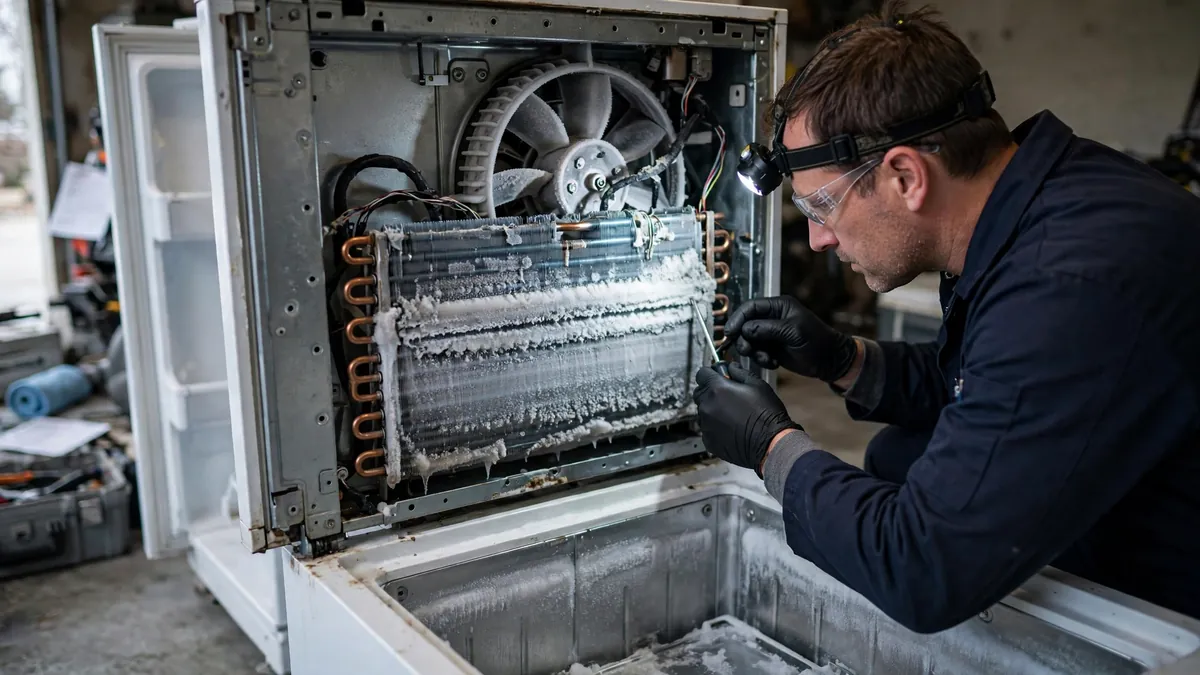
Start with how your fridge actually cools. There is only one cooling system, and it lives in the freezer. The evaporator coils sit behind the freezer’s back wall. Cold refrigerant flows through them. The evaporator fan blows freezer air across those coils. It pushes some of it up through vents into the fridge section. An air damper controls how much cold air flows through.
Think of it like a house with one furnace and two rooms. The freezer is the room with the furnace. The fridge gets its heat relief through a duct. If the duct closes or the blower dies, the furnace room stays fine while the other room suffers.
How cold air moves, step by step
- The compressor pumps refrigerant through the sealed system.
- The evaporator coils behind the freezer wall get very cold.
- The evaporator fan blows air across the coils and through the freezer.
- Some of that cold air travels up through vents into the fridge section.
- The damper opens and closes to hold the fridge at 37 to 40 degrees.
- A defrost heater melts frost off the coils every 8 to 12 hours.
Any break in steps 2 through 6 gives you the same symptom. The freezer keeps freezing. The fridge slowly warms. Now let us find your break.
The five parts behind this symptom
Evaporator fan motor. This is the number one cause. The fan moves cold air from the freezer to the fridge. When its motor dies, airflow stops. Listen at the freezer vents with the door open. If you hear no fan blowing, this is your suspect. Typical repair: $150 to $300.
Air damper. The damper is a small door between the freezer and fridge. It opens and closes to meter cold air. Dampers can stick shut, break, or freeze in place. A stuck damper blocks all cold air from reaching the fridge. Typical repair: $150 to $300.
Defrost system failure. The defrost heater, defrost thermostat, or defrost timer can fail. Without defrost cycles, frost builds on the evaporator coils until they become a solid block of ice. Air cannot pass through solid ice. The fan spins but moves nothing. Typical repair: $150 to $350.
Iced over vents. Sometimes the vents themselves freeze shut from humidity or a door left open. Warm air entered, moisture froze, and now the passage is blocked. A full manual defrost often clears this.
Control board. Rare, but a failed board can stop sending power to the fan or damper. Techs check this last, after ruling out the cheaper parts. Typical repair: $250 to $600.
Freezer works, fridge doesn’t: when your refrigerator is running but not cooling
Some people describe this symptom differently. They say their refrigerator is running but not cooling. If the freezer is still freezing while the fridge warms, you have the exact problem this guide covers. The diagnostic tree is the same: fan, damper, defrost.
But if BOTH sections are warm while the unit hums, you have a different problem. The cooling system itself has stopped. That means the compressor, the start relay, the control board, or the sealed system. Run these checks in order before you call.
Checks to run in order
- Check the outlet and breaker. Plug a lamp into the same outlet to confirm power.
- Check the temperature settings. Fridge should be 37 to 40 degrees. Freezer should be 0.
- Pull the fridge out and look behind it. Listen for the compressor humming.
- Listen for clicking every few minutes. That usually means a failed start relay. The relay is a small part on the side of the compressor.
- Clean the condenser coils. Use a coil brush or vacuum. Dust and pet hair kill cooling.
- Look at the freezer’s back wall. A thick sheet of frost points to a defrost failure.
If the freezer is cold and only the fridge is warm, start at step 6. Open the freezer and feel the back wall. Thick frost or a solid sheet of ice tells you the defrost system failed. The fan cannot blow air through iced coils.
The 24 hour defrost test
This test costs nothing and tells you a lot. Empty the fridge and freezer into coolers. Unplug the unit. Leave both doors open for 24 hours. Put towels on the floor to catch meltwater. Plug it back in and wait 4 hours.
If the fridge cools normally after the defrost, you confirmed the problem. Ice was blocking airflow. But the ice will come back. Something in the defrost system failed, and it needs a tech to find which part. If the fridge still will not cool after a full defrost, the fan or damper has failed mechanically.
What each repair typically costs
Prices below are typical ranges charged by shops across the US. Your quote depends on the brand and your market.
- Diagnostic visit: $60 to $130, often credited toward the repair
- Evaporator fan motor: $150 to $300
- Air damper: $150 to $300
- Defrost heater or thermostat: $150 to $350
- Control board: $250 to $600
Most freezer cold and fridge warm repairs land between $150 and $350. That is worth doing on any fridge under ten years old. Compare that to a compressor replacement, which runs $700 to $1,250. If a tech quotes sealed system work on a fridge past year ten, pause. Read our repair or replace guide before you say yes.
When it is safe to wait, and when it is not
A warming fridge is a food safety clock. The FDA says perishable food must stay at or below 40 degrees. Food left above 40 degrees for more than 2 hours should be thrown out. That rule matters more than saving the repair fee.
Call a tech today if you notice any of these.
- The fridge section reads above 40 degrees and is climbing.
- You hear clicking every few minutes from the back of the unit.
- The compressor runs nonstop but nothing cools.
- There is a burning smell or the outlet feels hot. Unplug the unit and call.
You can wait a day or two if the fridge holds under 40 degrees and the freezer stays at 0. Move milk, meat, and leftovers to the freezer or a cooler. Run the 24 hour defrost test. Keep the doors closed as much as possible.
Brand patterns worth knowing
Some brands fail in predictable ways. Samsung French door models from about 2015 to 2022 are famous for ice maker freeze ups. Their damper and fan parts can also be harder to source. If you own one, our Samsung page covers its weak points in detail. LG fridges from 2014 to 2017 have a known linear compressor weakness. But on an LG with this symptom, the cause is still usually the fan or defrost system. It is rarely the compressor. Our LG page has the full breakdown.
Strange buzzing or grinding along with the warm fridge? Read our fridge noise decoder. Match the sound to the failing part before the tech arrives.
Tried the checks and the fridge is still warm?
Then it is time for a pro with the right parts on the truck. Our techs fix warm fridge complaints daily. We check the fan, damper, and defrost system in one visit. You get a flat rate before any work starts. Call [TODO: phone number] to book. [TODO: business name] offers same day and next day refrigerator repair. We serve Milwaukee, Sacramento, and Grand Rapids. The diagnostic fee is credited toward your repair, so the visit costs you nothing extra if you say yes.
Frequently asked questions
Why is my freezer cold but the fridge warm?
Cold air is made in the freezer and blown up into the fridge section. When the freezer stays cold but the fridge warms, the usual cause is a failed evaporator fan, a stuck air damper, or a defrost failure that has iced the coils solid. The compressor is rarely the problem. A full 24 hour defrost buys time, but a tech needs to find which part failed.
Why is my refrigerator running but not cooling?
If you hear it running but both sections are warm, the problem is different from the freezer cold and fridge warm case. Check the breaker, the outlet, and the temperature settings first. Clean the condenser coils. A clicking sound every few minutes points to a failed start relay. No sound at all can mean a compressor or control board failure.
How long does it take to defrost a refrigerator?
A full manual defrost takes about 24 hours with both doors open and the unit unplugged. Place towels on the floor to catch meltwater. A thick sheet of ice on the freezer's back wall can take the full day to melt. This is a temporary fix. If ice caused the problem, it will come back until the failed defrost part is replaced.
Can dirty condenser coils cause the fridge to stop cooling?
Dirty coils strain the whole cooling system and can stop it completely. When dust and pet hair cake over the coils, heat cannot escape. The unit runs longer and cools less. Clean the coils twice a year with a coil brush or vacuum. This free fix solves more cooling complaints than most people expect.
Is it worth repairing, or should I buy a new fridge?
Use the 50 percent rule. If the repair costs more than half of a comparable new fridge, replacement usually wins. Most freezer cold and fridge warm repairs cost $150 to $350, which is worth doing on a fridge under ten years old. A failed compressor on a fridge past year ten is usually not worth fixing.
Broken appliance? We're one call away.
Same-day appliance repair across 37 cities. Upfront pricing, written warranty, and an honest repair-or-replace answer on every job.
Call +1 (888) 206-0056